
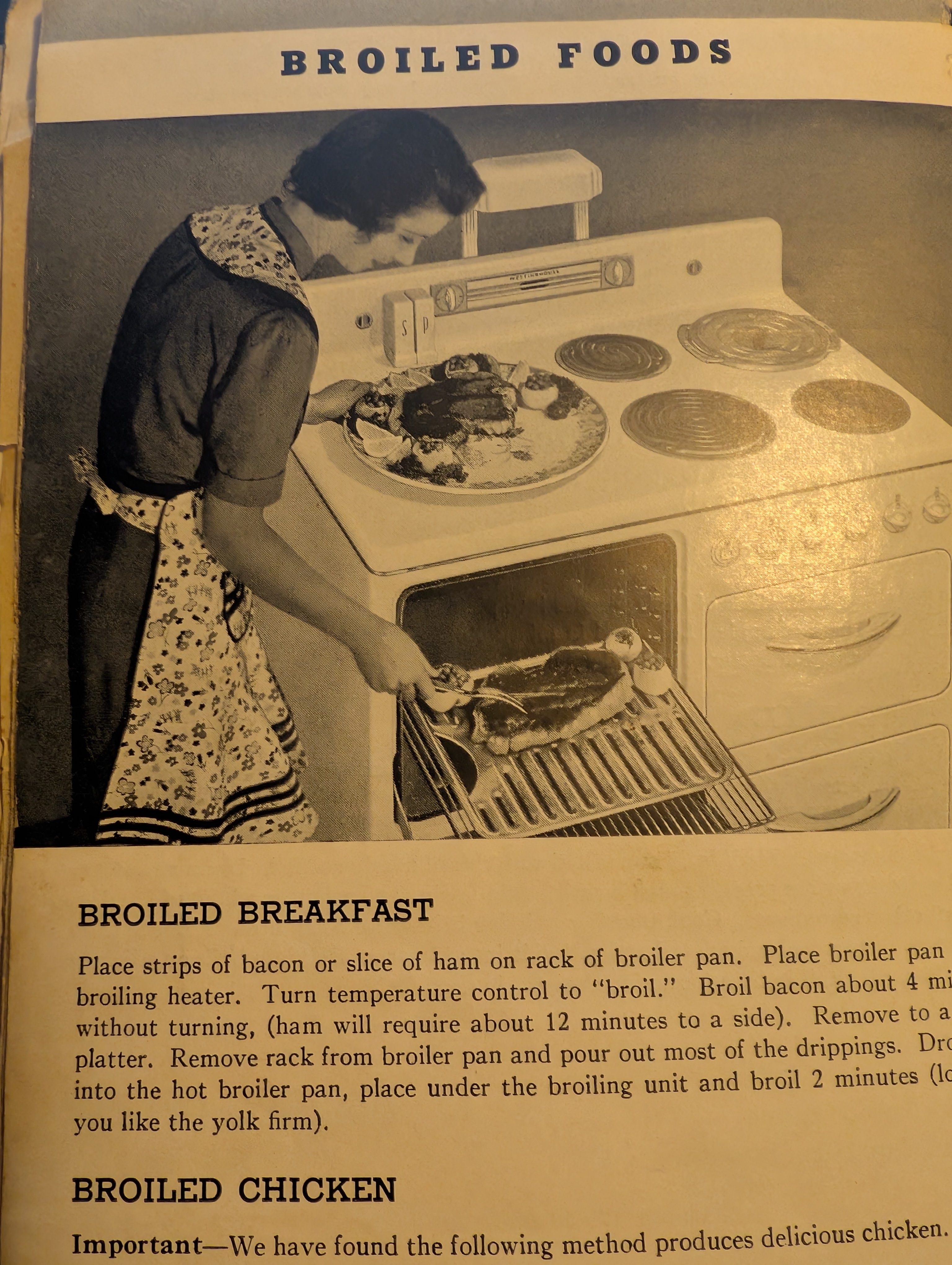
Welcome back to Episode Eight of The Lost Cookbooks Show! Today, we’re stepping back into 1936. The Great Depression had a firm grip on the country, yet a gleaming, porcelain promise of modern convenience was adorning American kitchens. The 1936 Westinghouse Electric Range Cookbook and appliance manual didn’t just teach homemakers how to roast a chicken—it was a bold piece of marketing designed to usher in a completely new, electrified way of living.
The Royal Lineup: Emperor, Regent, and Dictator
If you flip through the pages of the 1936 manual, you’ll notice Westinghouse didn’t give their ranges humble names. They wanted these appliances to feel like powerful, majestic additions to the modern home. The catalog featured a “royal” lineup of freestanding models:
- The Emperor: The flagship of the Westinghouse fleet. Advertised with the slogan, “Introducing new ranges that will Electrify America”, this model featured dual ovens, gleaming chrome hardware, built-in timer clocks, and ample warming drawers.
- The Regent: A step down from the Emperor but still a high-end luxury model. It offered a streamlined body and the latest automatic heat controls, bringing absolute precision to baking.
- The Dictator: Billed as the “New 1936 Cooking Marvel.” While the name might raise eyebrows today, in 1936, the term “Dictator” was chosen to symbolize absolute control—specifically, the homemaker’s new ability to control temperatures without tending to a coal or wood fire. Needless to say, this naming convention was quietly retired a few years later as geopolitical tensions rose in Europe!

Sticker Shock: What Did They Cost?
In the mid-1930s, an electric range was a massive luxury. The price of a premium Westinghouse range typically ran between $135 and $300 depending on the model and optional features.
To put that in perspective, the average American’s annual income in 1936 was around $1,500. Adjusted for inflation in today’s money, that $135–$300 price tag translates to roughly $3,200 to $7,200. For a country still clawing its way out of the Great Depression, buying a stove outright was completely out of reach for the average family.
The Ingenious Solution: Power Bill Installment Plans
If families couldn’t afford the upfront cost, how did Westinghouse manage to sell them? The answer lies in a brilliant partnership with local power companies and rural cooperatives.
Utility companies needed families to actually use electricity to make running the expensive new power lines profitable. A single lightbulb in the living room wasn’t going to cut it; they needed homes to adopt heavy power-drawing appliances. To solve the affordability crisis, utility companies rolled out appliance installment plans:
- No Money Down: Families could have a brand-new Emperor or Dictator range delivered to their kitchen with little to no down payment.
- Billed on the Meter: The cost of the appliance was broken down into tiny micro-payments and added directly to the family’s monthly electric bill.
- The Guarantee: The utility company benefited twice—they financed the stove, and they profited from the electricity the new stove consumed. If a customer stopped paying, the utility could simply shut off their power or repossess the appliance.

The Economy Cooker: The Original Slow Cooker
The 1936 Westinghouse ranges were heavily marketed as tools of extreme efficiency. Before the countertop slow cooker was invented, these ranges featured what Westinghouse called the Economy Cooker.
Instead of sitting on top of a burner, the Economy Cooker was a large, heavy aluminum pot (usually 5 to 7 quarts) that dropped directly down into a recessed, heavily insulated cavity in the stovetop.
- Pennies to operate: A homemaker could turn the heating element on high to bring a stew or roast to a rapid boil. Once boiling, she could turn the dial down to “Simmer” or switch it off completely. The thick insulation retained the heat so well that the food would continue to cook for hours using barely any electricity.
- Cheap cuts of meat: The Great Depression forced families to buy cheaper, tougher cuts of meat. The low-and-slow moist heat of the insulated Economy Cooker was perfect for tenderizing chuck roasts and boiling hams.
The Automatic Timer: The Gift of Free Time
If you look closely at the backsplashes of the high-end Emperor and Regent models, you’ll see a beautiful, built-in electric clock. This wasn’t just to tell time; it was a highly sophisticated mechanical timer that gave women something they rarely had: the ability to leave the house.
Before automated electric ranges, cooking required constant supervision. With the new “Set it and Forget it” system, a homemaker could prep her entire dinner, place the roast in the oven, and set two separate dials:
- The “Start” Dial: Set for when she wanted the oven to turn on (e.g., 3:00 PM).
- The “Stop” Dial: Set for when the food would be perfectly cooked (e.g., 5:30 PM).
The mechanical clock would physically trip the heavy electrical relays to turn the heating elements on and off while she was gone. The 1936 cookbook specifically highlighted menus designed for “afternoon-away” cooking, proving that Westinghouse wasn’t just selling a kitchen appliance—they were selling a modern, liberated lifestyle.
Vote on Our Next Vintage Recipe!
The back of this 1936 cookbook has 31 oven meals listed, which are complete meals featuring a meat, three sides, and a dessert—all designed to be baked together in the super oven.
I will be adding 4 of these complete meals to my YouTube Poll for you to vote on. The one that wins, I will make the complete meal for the show (and Steve is already gearing up for the taste test!).
Voting closes on Tuesday, September 15, 2026, at 12:00 noon EST.
It may take me a little longer to make this massive meal in my small Kenmore oven instead of a mighty Westinghouse Emperor, but I will do my absolute best.
Do you remember a family member having one of these Westinghouse Ranges? Let me know in the comments!
Leave a Reply